Scrum
Scrum is an agile process framework that has proven to work in project/product development environments that experience rapid change and/or emergent requirements. The complexity in these efforts can result from the domain,
number of people involved, compression in time, emergent feedback and more. Scrum is suited for projects that require the combined intellect of more than one individual. The problems that we tackle with Scrum require the combined focus of a team.
Agile processes have been thrust into the limelight by the work done in the area of software development. Software development is unique due to its rapid feedback loops. Further, software development is unique because many of these feedback loops can be compressed and learning can take place sooner. Unlike other human efforts, software has been one the fastest models for understanding intense human collaborative efforts.
Despite software development being new relative to man’s history on the planet, it has offered us a chance to rapidly learn what works well for intense collaborative efforts. Most of the efforts in software development sit on the boundary between complex to chaotic. Software development has enabled a rapid viral model for understanding how people work together to build complex things. The Scrum framework has demonstrated broad applicability to any endeavor of work that lives within the complex to chaotic boundary for a team’s work.
Scrum is a project or product development method that contains short rapid cycles for evolving product. These rapid cycles have enabled software development to move from an area of almost pure art, to creative craft, with well understood engineering practices that support the craft. The same rapid cycles have revealed better ways to tune human collaboration and improve combined effort. As a result, we see Scrum and other agile methods being broadly applied to other challenging efforts where complexity reigns.
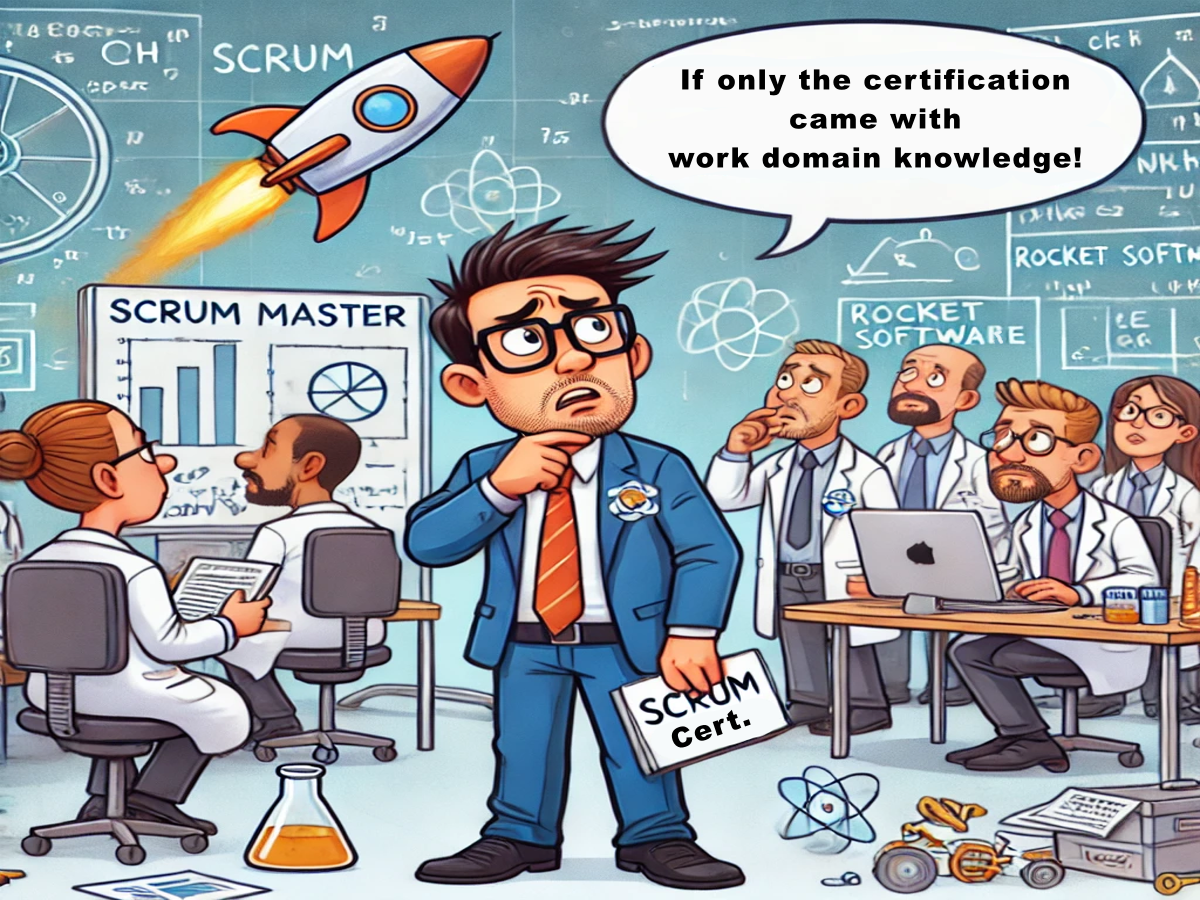
Roles in the Scrum process can be used as a shorthand for understanding the framework.
- ScrumMaster dedicated to team health
- Product Owner drives the product direction
- Team provides the energy to get there
Use:
Scrum development is for more than just software development. It was born from the need to create software, but is much more about enabling rapid intense human collaboration. Because Scrum enables such rapid feedback, it has proven itself in many domains other than software and has become generally applicable to cognitively intense knowledge work for teams. With Scrum, you can build and then apply the intellectual muscle of a team. When Scrum is applied with care, a well-formed team becomes focused on delivering business value.
Scrum is for managing and performing complex work. Scrum is a social agreement to be empirical as a team. Scrum follows Agile’s 2 Big Rules.
Scrum challenges us to rethink some of our most vexing organizational problems. One of those problems is performance review systems or compensation models. Classic performance review systems are often not team oriented, but evaluated on an individuals performance. This is not surprising when you look at the difficulty of accounting for team behavior. The downfall of too much focus on the individual is that we discourage team behavior and it becomes a game of maximizing an individual’s perceived benefit. Designing balanced performance systems for that hit the sweet spot between recognizing individuals vs. teams continues to be a difficult topic. There is no silver bullet formula. Ask for more information on this topic if you are interested.
Summary
Scrum is about humanizing the process so that a team can optimize it’s pursuit of a goal.