

1. Introduction: The Recurring Failure Pattern
There is a recurring failure pattern that shows up across organizations, technologies, and eras. It is not limited to software, and it is not the result of bad intentions or lack of skill. It appears in teams that are capable, motivated, and often doing work that looks successful on the surface.
You see it in specific kinds of environments, especially where speed and abstraction are easy to acquire:
- Framework-rich languages and framework-heavy architectures
- Interpreted and metaprogramming environments
- Knowledge-dense artifacts such as courses, playbooks, or internal frameworks
- AI instruction systems and prompt-layered workflows
- “Vibe coding” workflows
- Toolchains with many tightly coupled components
Systems rarely fail when they stop functioning. They fail earlier than that. They fail when the people responsible for them lose the ability to change them with confidence.
At the beginning, things feel tractable. The system makes sense. Changes are local. Cause and effect are visible. People know where to look and what to touch. Over time, speed increases. Abstraction increases. Tooling improves. Frameworks accumulate. Surface area grows. None of this is inherently bad. In most cases, it is exactly what teams are trying to achieve.
Then something subtle shifts.
The pattern usually looks like this:
- Changes no longer feel local.
- Small adjustments appear to have distant, delayed, or unclear effects.
- Teams hesitate before modifying things that technically still work.
Language changes along with behavior. Phrases like “don’t touch that,” “we’ll break something,” or “the system does weird things if you change it” start to appear. Nothing is obviously broken. Metrics may still be green. Delivery may even continue at speed. But confidence is gone.
This is not primarily a product-quality problem or an outcome-quality problem. Outputs can remain acceptable for quite some time. What has changed is the human relationship to the system.
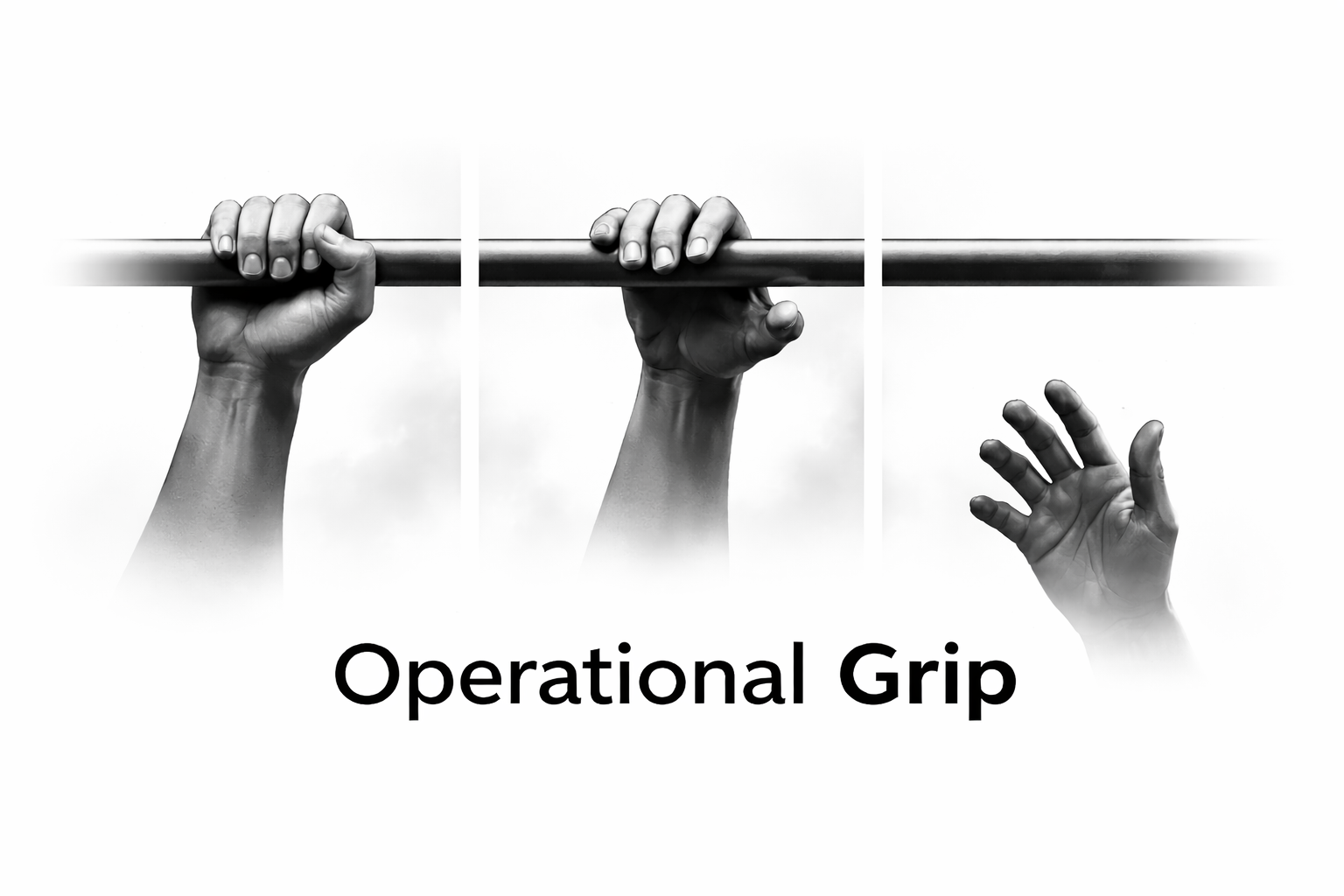
Systems fail not when they become unintelligible, but when we lose Operational Grip: the human ability to apply intentional, local change with predictable effect. At its core, this is about humans maintaining intentional control over evolving abstractions.
The rest of this paper names that loss more precisely, describes the conditions under which it occurs, and explains why it almost always precedes more visible failures later on.
2. From Expressiveness to Loss of Control
Modern systems are optimized for expressiveness. We build tools, languages, frameworks, and workflows that let us do more with less effort. We can move faster. We can compose larger behaviors out of smaller parts. We can abstract away details that used to demand constant attention.
Expressiveness refers to the ease and speed with which abstraction can be created, not a separate concept from abstraction itself.
This is a genuine advance. Expressiveness is not a mistake. It is how small teams build large systems and how individuals amplify their impact.
Expressiveness optimizes for a few clear things:
- Speed of change
- Power and reach
- Composability across layers
- Reduced friction in the moment
Early on, these benefits dominate. Teams feel productive. Progress is visible. The system responds quickly to intent. Abstraction feels like leverage.
What expressiveness hides, however, is not complexity itself, but the cost of interacting safely with that complexity.
As abstraction accumulates, certain properties change quietly.
What abstraction tends to hide:
- The perceived propagation distance of change
- Coupling across layers that are no longer visible at the point of action
- The cognitive cost of making a change without unintended side effects
None of these show up as errors. Nothing breaks immediately. In fact, high expressiveness often delays negative feedback. Systems continue to function. Outputs continue to appear correct. This delay is part of the problem.
Negative feedback plays a specific role in human-system interaction. It does not tell us what the right answer is. It only tells us that a particular move was wrong. That constraint is often the most reliable signal available, especially when the system is too complex to model directly.
Delayed negative feedback is dangerous because it weakens the system’s ability to falsify our mistakes early.
When falsification is delayed, mistakes are not corrected. They accumulate. Teams continue moving in a direction that feels productive, even as local reasoning degrades. By the time negative feedback finally arrives, it is often no longer attributable to a specific decision or change.
This is how loss of Operational Grip emerges without a clear breaking point. The system remains powerful. It may even appear more capable than before. But the human ability to steer it through small, intentional changes erodes as feedback becomes slower, noisier, and harder to interpret.
Power continues to grow. Control quietly slips.
3. Defining Operational Grip
Definition
Operational Grip is the ability of a human to apply intentional, local changes to a system with predictable effects, without requiring global reasoning.
Clarifications
- Grip is not understanding.
- Grip is not correctness.
- Grip is not safety guarantee.
- Grip is actionable control.
Why “grip”
- Suggests contact, resistance, and effort.
- Allows for gradual degradation rather than binary failure.
- Explains why fear appears before visible failure.
Grip is an agency condition, not a quality guarantee. It does not ensure correctness or safety. But it has a predictable ethical consequence: when teams lose Operational Grip, they rarely fail immediately. Instead, they begin lying to themselves in order to maintain momentum, and that is how Standard of Care quietly erodes without anyone declaring a failure.
Note: “operational” grounds grip in service of intended purpose or value, not abstract capability or elegance.
Note: “system” refers to the work under development, and that loss of Operational Grip concerns the human–work interaction, not people in isolation.
4. The Three States of Operational Grip
As systems evolve, Operational Grip does not disappear all at once. It degrades in recognizable ways. Teams tend to move through a small number of stable states before reaching outright dysfunction.
These states are not judgments about quality or intent. They describe how the human ability to act intentionally changes as abstraction accumulates.
4.1 Comprehensible and Wieldable
This is the state most teams start in, and the state they try to preserve.
- Local reasoning is sufficient.
- Change effects are bounded and observable.
- Confidence is high.
In this state, people can make small changes, observe outcomes, and adjust. Mistakes are recoverable. Negative feedback arrives quickly enough to constrain behavior. The work responds proportionally to intent.
Operational Grip is strong.
4.2 Comprehensible but Unwieldable
This is the most common failure state, and the most dangerous.
- Explanation survives, but influence degrades.
- Action degrades.
- Action localizes to safe edits.
- Changes require whole-system simulation.
- Fear begins.
Teams can still explain the system. They can diagram it. They can describe how it is supposed to work. What they can no longer do is change it safely without extensive planning, rehearsal, or justification.
Local changes stop feeling local. Every edit feels risky. Negative feedback is delayed or hard to attribute. Hesitation appears, even when nothing is visibly broken.
Operational Grip is slipping.
4.3 Ritualized and Untouchable
In this state, the system is no longer actively shaped. It is defended.
- Definitions replace edits.
- “Don’t touch that” zones form.
- Conceptual debates emerge.
- Evolution becomes efficiency-bound.
Work shifts from making changes to explaining why changes are dangerous. Conversations become theoretical. Arguments about meaning, purity, or intent replace experimentation. The system continues to exist, but it no longer adapts.
Operational Grip is effectively gone.
This is where large frameworks, instruction systems, and framework-rich environments tend to converge when left unchecked.
5. Observable Failure Signals
(How You Know You’ve Gone Too Far)
Loss of Operational Grip is not subtle if you know what to look for. It announces itself through changes in behavior long before outcomes fail or defects appear.
These signals are not technical metrics. They are behavioral responses to a system that no longer supports intentional action.
- Local changes require global reasoning.
- Hesitation appears when modifying working code.
- Teams do not fail immediately after losing grip; they begin lying to themselves to justify shortcuts that preserve forward motion.
- Post-hoc justification replaces a priori intent.
- Conceptual or definitional debates increase.
- Tool feedback no longer restores confidence.
- Fear appears without visible defects.
Fear takes many forms. It can manifest as avoidance, anxiety, deferral, disengagement, job turnover, or the quiet loss of key personnel.
Individually, these signals are easy to rationalize. Collectively, they indicate that the relationship between the human and the work has shifted.
Operational Grip is already compromised by the time these patterns become normal.
6. The Inward-Facing Discipline: Preserving Grip
Operational Grip does not fail because teams are careless. It fails because abstractions grow faster than humans can keep up with them. The work becomes harder to steer locally, and the human relationship to the work shifts from intentional control to cautious avoidance.
This discipline is inward-facing. It is not about tool choice or architectural purity. It is about how humans work, think, pause, and change the work over time.
6.1 The Inevitability of Drift
No system remains wieldable indefinitely.
As work progresses, abstraction naturally accumulates. Layers are added. Concepts are compressed. Over time, conceptual control drifts. Drift is structural, not a feeling. It is what happens when accumulated abstraction outgrows the cognitive surface area available to keep it coherent.
The goal is not permanent stability. The goal is to maintain workability: the ability for humans to intervene intentionally, recover from mistakes, and adapt the work as conditions change.
6.2 Rhythm as a Control Surface
Core thesis: Operational Grip is preserved when the rhythm of human capacity matches the cognitive weight of the system and the feedback constraints of its environment.
Cognitive weight increases as work becomes more layered, more indirect, and more semantically dense. Each added layer increases the amount of state a human must hold to make a safe change. At some point, the limiting factor is no longer capability in the tool. It is the ability to maintain coherent intent while the work is in motion.
Cognitive weight increases with:
- Layering
- Indirection
- Semantic density
Faster loops are not always safer. Rapid iteration can stabilize lightweight work because feedback is immediate and integration is easy. In heavier work, fast cycles can destabilize because changes accumulate faster than understanding can re-form.
A second rhythm is also at play: the rhythm of feedback from the environment. When the rhythm of change outpaces the rhythm at which the environment can provide meaningful feedback, action becomes unconstrained and justification fills the gap.
6.3 Cognitive Integration Time
Understanding does not form at the same rhythm as execution.
Subconscious processing matters. Familiarity is earned through exposure over time: repeated contact, reflection, and return. Intent often re-forms during pauses, not keystrokes. This is not a preference. It is how humans integrate complex systems.
When integration time is eliminated, Operational Grip erodes even if productivity appears high. Work continues, but steering is lost.
7. Application Across Domains
Operational Grip is not confined to software. The same loss pattern appears wherever humans work inside systems that accumulate abstraction.
- Framework-heavy systems
Early leverage gives way to negotiation with the framework itself. Local change stops being local. Explanation survives longer than the ability to intervene safely. - Interpreted and meta-programming environments
Expressiveness accelerates abstraction. Indirection compounds. Feedback arrives late or ambiguously. Systems remain comprehensible while becoming difficult to steer with intent. - AI instruction sets and agent frameworks
Behavior is defined indirectly through prompts, policies, and orchestration layers. Outcomes may appear acceptable while attribution degrades. Conceptual understanding persists after controllability has begun to slip.
The point is not that these domains are flawed. It is that the same human constraints apply across them. Where abstraction grows, feedback is delayed, and rhythm misaligns, Operational Grip degrades in the same way.
8. What This Is Not
This paper makes a narrow claim. To keep it narrow, it helps to be explicit about what it is not.
- Not an argument against abstraction.
Abstraction is how humans scale thought and effort. The issue is not abstraction itself, but abstraction that grows faster than our ability to work with it intentionally. - Not a plea for slower work.
Speed is often necessary. The problem is not speed, but speed without grip. When rhythm outpaces feedback and integration, forward motion becomes unstable. - Not a tooling manifesto.
No language, framework, platform, or methodology is being endorsed or rejected. The patterns described here arise from human limits, not technical choices. - Not a completeness claim.
Operational Grip names one recurring failure mode and one discipline for resisting it. It does not explain everything that can go wrong, and it does not attempt to.
9. Conclusion: Intent as the Scarce Resource
Most modern systems are not constrained by capability. They are constrained by human agency.
- Speed is abundant.
We can change things quickly, often faster than we can understand the consequences. - Power is abundant.
Tools, platforms, and automation amplify what small groups can do. - Abstraction is abundant.
We can compress complexity into layers, frameworks, and representations with ease.
What is scarce is something else.
- Sustained human agency.
- The ability to make intentional change.
- Operational Grip.
When Operational Grip is present, humans can steer systems through small, deliberate moves and recover when they are wrong. When it is lost, systems may continue to function, even appear successful, while humans quietly lose the ability to influence outcomes with confidence.
This paper has argued that systems do not fail when they become unintelligible. They fail when humans lose the ability to act intentionally within them. Naming that loss matters, because it appears early, progresses predictably, and can be resisted with discipline.
Operational Grip is not about control for its own sake. It is about preserving the human capacity to shape work as it evolves, before explanation replaces action and momentum replaces intent.
Footnote: On Feedback Opportunity (“Carpe Diem”)
- Acknowledge that feedback availability also shapes safe rhythm.
- Note that validation loops interact with cognitive weight.
- Explicitly defer full treatment.
Footnote: Related Concepts and Distinctions
This paper overlaps conceptually with prior work in cognitive control, leaky abstractions, and second-order cybernetics, each of which addresses aspects of human cognition or observer participation in complex systems. However, those frameworks focus primarily on internal cognitive mechanisms, abstraction boundaries, or epistemological stance. Operational Grip is proposed as a distinct construct: it names the human ability to apply intentional, local change with predictable effects in evolving systems, and it emphasizes observable failure signals and downstream erosion of Standard of Care rather than internal cognition or system design alone. I have not found an existing term that captures this combination.

Leave a Reply