


Introduction
When thinking about investing in product development through Scrum, a helpful metaphor is a jigsaw puzzle. Each piece—every story—needs to fit with others to form part of a larger, partially visible picture. Although Scrum encourages teams to create independent stories, these pieces are never truly independent. To succeed, teams must ensure that individual stories interlock into a coherent whole.
But here’s the challenge: the complete picture of the puzzle isn’t visible at the start, and the pieces will change along the way. This article explores a better way to invest your time and energy in understanding how stories and epics fit together to drive meaningful results.
1. Stories and Epics: Fitting the Puzzle Together
In every Scrum Team’s backlog, you’ll find items of various sizes. Some are small, well-defined stories, while others are larger, ambiguous epics.
- Stories represent the smallest, actionable units of value. They are self-contained tasks the team can complete in a sprint.
- Epics are larger efforts, consisting of multiple stories. They typically represent capabilities or major stakeholder goals.
Each sprint is like adding pieces to the puzzle, where every story delivers part of the value. However, while individual stories are worked on independently, they must align with the larger picture, much like puzzle pieces fitting together.
2. The Illusion of Independence and Interconnected Stories
Scrum encourages teams to design independent stories using the INVEST criteria. Ideally, each story should be self-contained and able to stand on its own within a sprint. However, in practice, even the most independent stories are connected through dependencies and shared outcomes.
For example:
- Story A may provide a front-end feature, while Story B delivers the back-end infrastructure for it. While both stories are distinct, they must work in harmony to achieve a unified outcome.
- Unexpected dependencies often arise, just as puzzle pieces don’t always fit where you expect.
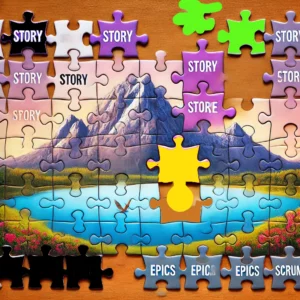
This reflects the reality of product development: the bigger picture evolves over time. Product Owners and teams uncover new connections and insights as they progress. Like a puzzle being solved, the solution emerges incrementally.
3. Working with an Evolving Puzzle
Building a product is like working with a puzzle where the full picture is incomplete and some pieces are missing at the start. Just as a jigsaw puzzle requires anchor points like edge pieces, your team needs sprint goals and clear priorities to stay on track. These goals create boundaries for the work, helping the team make progress even when the full vision isn’t yet clear.
Here are key practices for handling evolving work:
- Some puzzle pieces will change or no longer fit. Similarly, stories often need to be reshuffled, rewritten, or even discarded as priorities shift.
- Let go of work that no longer aligns with the evolving product vision. This ensures the team stays focused on what matters most.
4. Practical Tips: Making the Puzzle Work
Here are some practical ways to ensure stories and epics fit together effectively:
- Story Refinement: Define just enough detail to get started. Further insights will emerge through development, so avoid over-refining tasks before the sprint.
- Epic Decomposition: Break down epics thoughtfully into smaller, related stories. Ensure every story contributes toward an overarching capability or stakeholder goal.
- Continuous Alignment: Regularly check with the Product Owner to ensure stories still align with the evolving product vision.
Lean into Flexibility: Use the lean principle of delaying decisions until the last responsible moment. This allows the team to adapt quickly based on new information.
Conclusion: A Better Way to Invest
Investing in understanding the relationship between stories and epics is crucial for Scrum Teams. Just like assembling a jigsaw puzzle, teams must balance independent execution with coordinated alignment. Although Scrum emphasizes working with small, manageable stories, these stories are part of a larger, evolving whole.
Moreover, the product vision evolves continuously, meaning the team must adapt and remain open to change. Some puzzle pieces will no longer fit, and new pieces will emerge. Each sprint brings the team closer to completing the product, even if the final picture remains a delightful mystery.Ultimately, success lies in embracing the independence of individual stories while navigating the uncertainty of the evolving product vision. With every sprint, the puzzle becomes clearer—and the team invests smarter, not harder.
Would you like help with your Backlog?

For organizations seeking to refine their approach to value delivery and build a strong, adaptive backlog. Try our Scrum Application Workshop on Shaping Backlogs to Improve Flow and Avoid Complexity is designed to help solve your puzzles. This one-day, on-site event is tailored to your company’s specific needs. It’s an applied 1-day tailored session aimed at helping teams tackle real-world challenges.
References
Extended Agile Manifesto – ScrumGuide Organization
The Agile Manifesto encourages responding to change over following a plan, which perfectly ties into the concept of reworking misshapen stories that don’t align with the evolving product vision. As stories and epics evolve, teams need to adjust and rework their backlog, much like reshaping puzzle pieces to fit the emerging picture. You can explore more about the Agile approach and continuous adaptation in the Extended Agile Manifesto here:
ScrumGuide.org
Scrum Mastering II: Building Great Teams – 3Back LLC
In the context of Scrum, not all stories fit into the bigger picture immediately. Teams often encounter stories that need reshaping or reworking to match the product vision, just as puzzle pieces need adjusting to fit. ScrumMastering emphasizes this iterative process, guiding teams to refine and align their backlog stories with their epics effectively. For more on this, refer to Scrum Mastering II:
ScrumGuide.org

Leave a Reply