


Business Value and ROI with Scrum – How do I maximize them?
Imagine laying the first stone of a wall on a vast, uneven landscape. You don’t know what the full structure will look like, or how the terrain will change. Each stone you place guides your next placement. Over time, the wall takes shape—but why did you start building it in the first place? And how do you know it will serve its purpose?
The First Stone – Defining Purpose and Business Value in Scrum
Every project starts with a single decision, like laying the first stone of a wall. At this moment, the goal might seem clear: protect livestock, create boundaries, or make use of available materials. Yet, with that first stone, you also establish constraints and opportunities that shape the entire wall—and, ultimately, the business value it provides.
In Scrum, this is no different. We often begin with an idea, a vision for how things could be better, more efficient, or more profitable. But as we start to build, we must continually ask: What problem are we solving? What benefits do we hope to deliver? The wall (or project) must align with our purpose—whether it’s to pen sheep, protect crops, or create something entirely new. The purpose remains fixed for some period of time. Long term our purpose will change so we get our work done in sprints while we can.
When estimating business value and ROI in Scrum, this purpose guides our every step. Just as you wouldn’t start a wall without knowing its function, we shouldn’t start projects without clarity on what value they intend to deliver—concerns of a Product Owner.
An Evolving Wall – Managing Complexity and Business Value in Scrum

Building a wall is never straightforward, especially when the landscape is unpredictable. You start with a vision, but as the wall grows, it encounters rough terrain, unforeseen curves, and evolving needs. Suddenly, you’re not just penning sheep; you’re asked to pen pigs too, each requiring different approaches and materials.
This mirrors the challenges of product development and project management in Scrum. What starts as a simple idea quickly becomes a complex balancing act of priorities, resource constraints, and stakeholder needs. Markets shift, customer demands evolve, and teams change—all affecting how the wall should be built.
The complexity lies in the unexpected changes, the new information that reshapes your approach. This is where Scrum’s iterative cycles and flexible planning come in. Cycles (Sprints) help to break down complex problems into manageable, actionable steps. Each sprint is like adding a section to the wall, adapting as you go while ensuring you’re still aligned with your overall purpose and delivering business value.
Stones, Resources, and Skills – Navigating Constraints in Scrum
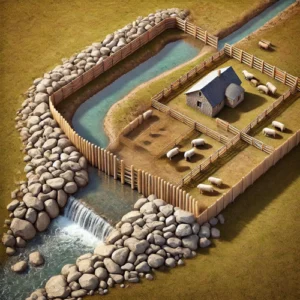
Every builder eventually faces a supply problem. As you exhaust the easy-to-find stones from the local landscape, the work changes. What once was a simple matter of digging up stones now requires creativity: finding new materials, or perhaps using wood, mud, or even water to support the structure. And as the terrain shifts, so must your thinking.
In Scrum projects, we face similar constraints. Resources change, and our access to them becomes more challenging as we progress. Team members come and go, and their skills evolve. Perhaps your original team were expert masons, but now your workforce consists of woodworkers and dam builders. Suddenly, the wall is no longer just about stones—it’s about using the best materials and skills available to continue delivering business value.
The value isn’t just in the wall itself but in how efficiently and effectively you can adapt to changing resources and skills. A flexible approach to building allows you to explore the use of wood, damming rivers, or leveraging natural barriers to achieve your goals and maximize ROI in Scrum.
From Complex to Complicated – Finding Stability in Scrum
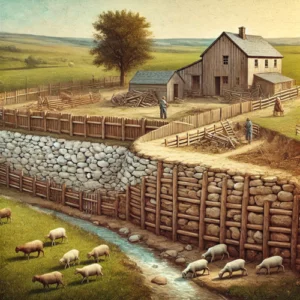
The journey of wall-building often begins in a complex state, where cause and effect are uncertain, and the path forward is not clear. There’s no blueprint—just possibilities. Each decision informs the next, as you move from a world of ambiguity to one of stability. As long as your purpose is fixed. It’s not a complex problem, it’s a complicated problem. The decision making of the Product Owner kicks in, to keep complexity at bay.
In Scrum terms, this transition moves the work from being complex to complicated. A complicated state is where the relationships between cause and effect are known, and team planning becomes agreement-based. You know you’ve reached this stage when your team can quickly reach consensus on ‘doneness’—the wall sections align, the gaps are filled, and you know where each stone belongs. This state of collaboration is what a championship team achieves.
Yet, as new challenges emerge—whether it’s penning pigs or adapting to new resource constraints—the problem can shift back into complexity. Scrum helps navigate this by breaking down work into manageable iterations, maintaining a focus on business value, and allowing teams to respond quickly to change.
Business Value and ROI in Scrum – Measuring What Matters

Throughout this journey, business value and ROI in Scrum are at the heart of the work. But how do you know if your wall is valuable? Is it the number of sheep saved? The ability to quickly adapt the wall to new terrain? The low cost of materials?
In Scrum, measuring business value and ROI can be as fluid as the wall-building process. It’s not just about tracking costs or profit margins but understanding the outcomes you’re driving toward—whether that’s customer satisfaction, faster delivery times, or innovation in your product line.
To measure ROI effectively, it’s crucial to connect your efforts to real-world benefits. For the wall, this could mean fewer lost sheep, improved security for your farm, or a stable perimeter that enhances your property’s value. In product development, it’s about delivering the features and improvements that truly make a difference to your stakeholders.
Your Next Step in Delivering Value
As you reflect on the walls you’re building—whether they’re literal or metaphorical—ask yourself:
- Do I know the value I’m aiming to deliver?
- Am I ready to adapt when faced with new challenges or complexities?
- Am I measuring what truly matters in terms of business value and ROI?

For organizations seeking to refine their approach to value delivery and build a strong, adaptive backlog. Try our Scrum Application Workshop on Delivering Business Value and ROI is designed just for you. This one-day, on-site event is tailored to your company’s specific needs. It’s an applied 1-day tailored session aimed at helping teams tackle real-world challenges.

Leave a Reply